Modern organizations face a constant stream of cyber threats—from ransomware to infrastructure attacks. Yet many enterprises still rely on traditional backup strategies as their primary line of defense. The problem? Backup alone does not guarantee recovery.
A true cyber resilience strategy goes further. It ensures that critical systems, applications, and data can be restored quickly and securely—even after a sophisticated cyberattack.
In this guide, we explain what enterprise cyber resilience really means, why it matters, and how organizations can build a recovery strategy that keeps operations running despite disruptions.
The registry is used as a critical tool for attackers to maintain control over a system.
of all resident malware adds itself to “Run” keys so it restarts every time you boot your PC.
of enterprise attacks use scripts or shellcode in “hidden” keys, allowing the virus to run entirely in your computer’s RAM.
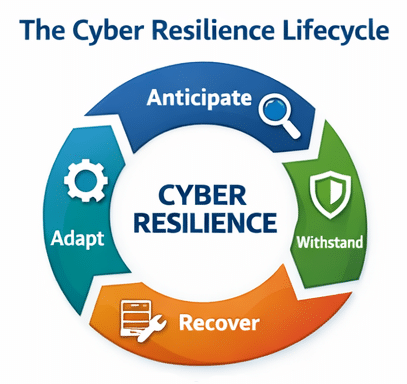
Cyber resilience is an organization’s ability to anticipate, withstand, recover from, and adapt to cyber incidents while maintaining business operations.
Unlike traditional cybersecurity—which focuses mainly on preventing attacks—cyber resilience assumes that attacks will happen and prioritizes rapid recovery and operational continuity.
A cyber resilient organization can:
In practice, this means combining security, backup, disaster recovery, and infrastructure recovery capabilities into a coordinated strategy.
Systems are restored into a virtual, isolated Clean Room environment.
✅
Automated and manual testing is performed to check for system integrity, malware remnants, or misconfigurations.
✅
Once verified, the systems are migrated back to the production environment, or transitioned into a new clean production state.
✅
Many organizations mistakenly treat cybersecurity and cyber resilience as the same thing.
They are closely related—but serve different purposes.
| Cybersecurity | Cyber Resilience |
|---|---|
|
Focuses on preventing attacks |
Focuses on surviving attacks
|
|
Protects systems and data |
Ensures systems can recover
|
|
Emphasizes detection and defense |
Emphasizes recovery and continuity |
Cyber threats have evolved dramatically in recent years.
Ransomware groups increasingly target infrastructure, operating systems, and backup environments, not just data files. Their goal is to prevent recovery.
This makes traditional backup strategies insufficient on their own.
Organizations need a cyber resilient disaster recovery strategy that can restore:
The faster this recovery happens, the less operational and financial damage an incident causes.
Backups that once written cannot be altered in any way.
A security framework based on the principle of “never trust, always verify”.
An integrated security solution that continuously monitors end-user devices to detect, investigate, and automatically respond to advanced cyber threats that traditional antivirus software might miss.
The comprehensive strategy for restoring full IT operations after a major catastrophe.
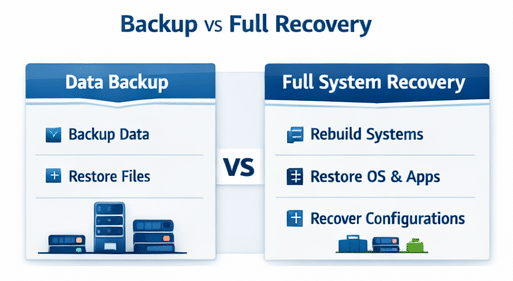
Many organizations believe that having backups means they are protected.
However, backup systems typically restore data, not complete systems.
After a cyberattack, teams may still need to:
This process can take hours or even days, dramatically extending downtime.
A modern enterprise cyber resilience strategy must therefore include automated system recovery alongside traditional backup.
“IBM’s 2025 Cost of a Data Breach Report noted that for 76% of organizations, the path to full recovery (including all secondary systems and data validation) actually extended beyond 100 days.”
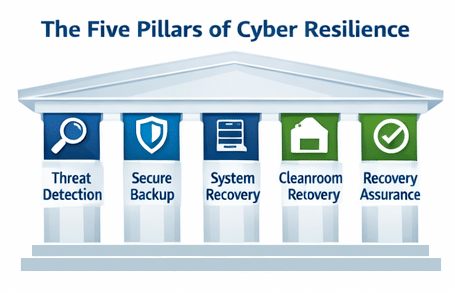
Building cyber resilience requires a combination of technologies and processes.
Early detection helps organizations respond quickly to suspicious activity.
This includes:
These systems identify unusual patterns that may indicate cyber threats.
Backup remains a critical component of cyber resilience.
Best practices include:
However, backup alone cannot guarantee full operational recovery.
After a cyberattack, organizations must restore entire systems—not just files.
This is where bare metal recovery becomes essential.
Bare metal recovery enables organizations to:
Solutions like Cristie Bare Machine Recovery (CBMR) automate this process, dramatically reducing recovery time.
Modern cyber recovery strategies often involve cleanroom recovery environments.
A cleanroom environment allows organizations to:
This approach has become a key component of ransomware recovery strategies.
Another critical pillar is continuous recovery assurance—the ability to verify that recovery processes work.
This involves:
Without testing, organizations may discover recovery failures only during an actual incident.
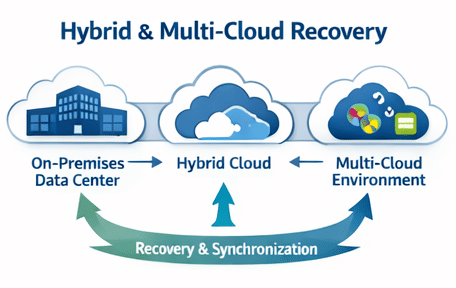
Enterprise environments are becoming increasingly complex.
Modern organizations often operate across:
Cyber resilience strategies must support recovery across all these environments.
This requires solutions capable of:
Cristie solutions integrate with leading data protection platforms such as Cohesity, Rubrik, Dell Technologies, and IBM, enabling automated infrastructure recovery across diverse environments.
Enterprise IT leaders should focus on three key priorities when developing a cyber resilience strategy.
Plan for the possibility that cyber defenses may fail.
Recovery capability becomes the last—and most important—line of defense.
Manual system rebuilding significantly increases downtime.
Automation reduces recovery time and minimizes operational disruption.
Disaster recovery plans must be tested regularly to ensure they remain effective as infrastructure evolves.
Continuous validation ensures organizations remain prepared for real incidents.
Cyber resilience is quickly becoming a core component of enterprise IT strategy.
Organizations are shifting from a traditional model of:
Prevent → Detect → Recover
to a resilience-first model:
Anticipate → Withstand → Recover → Adapt
This shift reflects a growing recognition that rapid recovery is just as important as prevention.
Technologies such as automated system recovery, cleanroom environments, and recovery assurance are becoming critical elements of modern resilience architectures.
For organizations looking to strengthen cyber resilience, the key question is not simply:
“Are our backups protected?”
It is:
“How quickly can we recover our infrastructure if an attack succeeds?”
Cristie Software helps enterprises answer that question by enabling fast, automated recovery of entire systems, minimizing downtime, and supporting secure recovery across hybrid and multi-cloud environments.
Cyber resilience is the ability of an organization to prepare for, withstand, recover from, and adapt to cyber incidents while maintaining business operations.
Cybersecurity focuses on preventing attacks, while cyber resilience focuses on ensuring systems and operations can recover quickly if an attack occurs.
Ransomware attacks often compromise entire systems. Cyber resilience ensures organizations can restore infrastructure quickly and securely, minimizing downtime and operational disruption.
System recovery enables organizations to restore complete operating environments—including OS, applications, and configurations—after a cyber incident, ensuring business continuity.