
Ransomware attacks continue to evolve in sophistication and impact. While most organizations maintain regular backups, many still discover a critical gap during ransomware recovery following a cyber incident:
Backup does not guarantee recovery.
Modern ransomware attacks often target infrastructure, operating systems, and backup environments themselves. As a result, organizations that rely solely on backup may struggle to restore operations quickly—or at all.
In this article, we explore why backup alone is not sufficient for ransomware recovery and how organizations can build a cyber resilient disaster recovery strategy capable of restoring entire systems after a ransomware attack.
The registry is used as a critical tool for attackers to maintain control over a system.
of all resident malware adds itself to “Run” keys so it restarts every time you boot your PC.
of enterprise attacks use scripts or shellcode in “hidden” keys, allowing the virus to run entirely in your computer’s RAM.
For many years, backup was considered the primary safeguard against data loss.
Backup platforms were designed to:
In these scenarios, organizations could simply restore the affected files or databases.
However, ransomware has fundamentally changed the threat landscape.
Today’s attacks often compromise:
This means that restoring files alone does not restore the business.
Systems are restored into a virtual, isolated Clean Room environment.
✅
Automated and manual testing is performed to check for system integrity, malware remnants, or misconfigurations.
✅
Once verified, the systems are migrated back to the production environment, or transitioned into a new clean production state.
✅
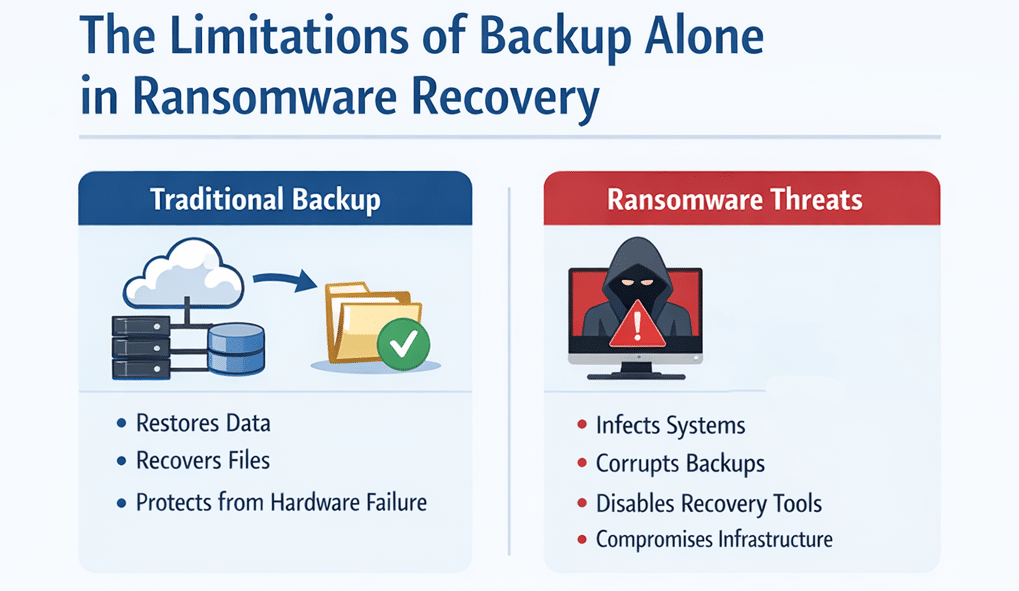
Ransomware groups increasingly target the recovery process itself.
Common attack techniques include:
Attackers may gain administrative access to servers and modify system configurations or disable recovery tools.
Many ransomware attacks attempt to:
Attackers often modify operating systems or registry settings to maintain access—even after partial recovery.
If these changes remain undetected, systems can become reinfected during restoration.
| Cybersecurity | Cyber Resilience |
|---|---|
|
Focuses on preventing attacks |
Focuses on surviving attacks
|
|
Protects systems and data |
Ensures systems can recover
|
|
Emphasizes detection and defense |
Emphasizes recovery and continuity |
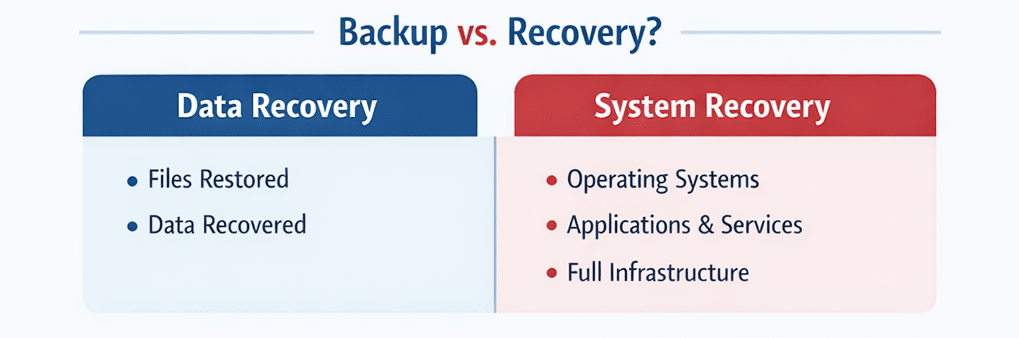
Backup platforms are excellent at restoring data.
But after a cyberattack, organizations often need to restore entire systems.
This includes:
Without automated system recovery, IT teams may need to rebuild servers manually before data can be restored.
This process can significantly increase downtime.
Backups that once written cannot be altered in any way.
A security framework based on the principle of “never trust, always verify”.
An integrated security solution that continuously monitors end-user devices to detect, investigate, and automatically respond to advanced cyber threats that traditional antivirus software might miss.
The comprehensive strategy for restoring full IT operations after a major catastrophe.
Recovering infrastructure quickly is essential for maintaining business continuity.
Organizations must be able to:
Technologies such as bare metal recovery allow organizations to restore complete systems—including the operating system and application stack—directly from backup data.
This significantly accelerates the recovery process.
Solutions like Cristie Bare Machine Recovery (CBMR) enable organizations to automate full system restoration across physical, virtual, and cloud environments.
“Full recovery is a marathon, not a sprint: IBM’s 2025 data shows that 76% of companies spend upwards of 100 days validating data and restoring infrastructure after an attack.”
Another emerging best practice is cleanroom recovery.
A cleanroom recovery environment provides an isolated space where systems can be restored and verified before being returned to production.
This approach helps organizations:
Cleanroom recovery is increasingly recommended as part of modern ransomware recovery strategies.
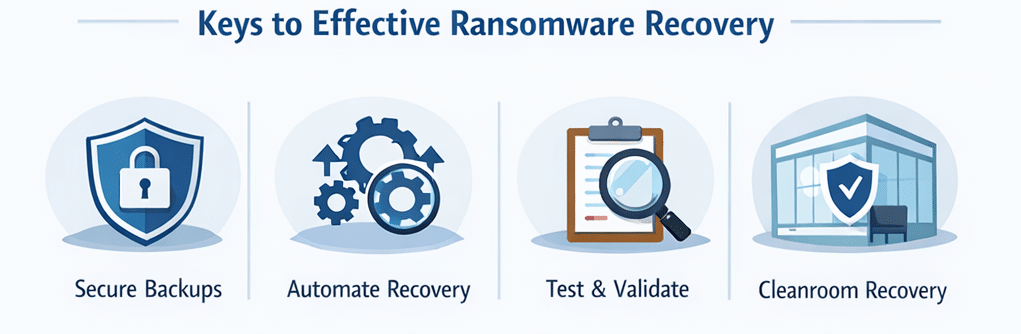
Organizations looking to strengthen ransomware recovery should consider the following steps:
Ensure backup environments are secured with immutability, isolation, and access controls.
Implement technologies capable of restoring entire systems—not just data.
Regularly test recovery procedures to ensure systems can be restored successfully.
Use isolated recovery environments to prevent malware reinfection.
Backup remains a critical component of data protection.
However, the ultimate goal of any resilience strategy is rapid operational recovery.
Organizations must be able to restore all of the following as quickly as possible after an incident:
By combining enterprise backup platforms with automated system recovery, organizations can dramatically reduce downtime and strengthen cyber resilience.
Cristie Software helps organizations bridge the gap between backup and recovery.
Cristie solutions enable:
The result is faster recovery times and minimal operational disruption after cyber incidents.
Backup protects data but does not automatically restore operating systems, applications, and infrastructure. After ransomware attacks, organizations often need to rebuild entire systems before restoring data.
Backup creates copies of data, while recovery restores systems and operations after an incident. Effective recovery requires restoring infrastructure as well as data.
Cyber resilient disaster recovery ensures organizations can restore systems and operations quickly and securely after cyberattacks such as ransomware.