When a cyberattack disrupts critical systems, speed of recovery becomes the most important factor in limiting business impact. Ransomware attacks, infrastructure compromise, and system corruption can render entire servers unusable. In these situations, organizations need more than file restoration—they need to rebuild systems from scratch. This is where bare metal recovery (BMR) plays a vital role in cyber incident response.
The registry is used as a critical tool for attackers to maintain control over a system.
of all resident malware adds itself to “Run” keys so it restarts every time you boot your PC.
of enterprise attacks use scripts or shellcode in “hidden” keys, allowing the virus to run entirely in your computer’s RAM.
Bare metal recovery is the process of restoring a complete system—including operating system, applications, and data—onto new or rebuilt hardware.
Unlike traditional recovery methods, which restore only files or databases, BMR restores the entire system environment.
This includes:
Bare metal recovery enables organizations to quickly return systems to a known working state after catastrophic failure or cyberattack.
Systems are restored into a virtual, isolated Clean Room environment.
✅
Automated and manual testing is performed to check for system integrity, malware remnants, or misconfigurations.
✅
Once verified, the systems are migrated back to the production environment, or transitioned into a new clean production state.
✅

Automated recovery orchestrates the restoration of infrastructure from backup data, enabling rapid rebuilding of compromised systems.
Cyber incidents often compromise systems at a fundamental level.
For example:
In these scenarios, restoring files alone does not resolve the problem.
The safest approach is often to rebuild systems completely from trusted backup sources.
Bare metal recovery enables this process.
| Cybersecurity | Cyber Resilience |
|---|---|
|
Focuses on preventing attacks |
Focuses on surviving attacks
|
|
Protects systems and data |
Ensures systems can recover
|
|
Emphasizes detection and defense |
Emphasizes recovery and continuity |
Without automated recovery tools, rebuilding systems can be slow and complex.
Typical manual recovery steps include:
For large infrastructures, this process can take many hours or even days.
Automation dramatically reduces this time.
Backups that once written cannot be altered in any way.
A security framework based on the principle of “never trust, always verify”.
An integrated security solution that continuously monitors end-user devices to detect, investigate, and automatically respond to advanced cyber threats that traditional antivirus software might miss.
The comprehensive strategy for restoring full IT operations after a major catastrophe.
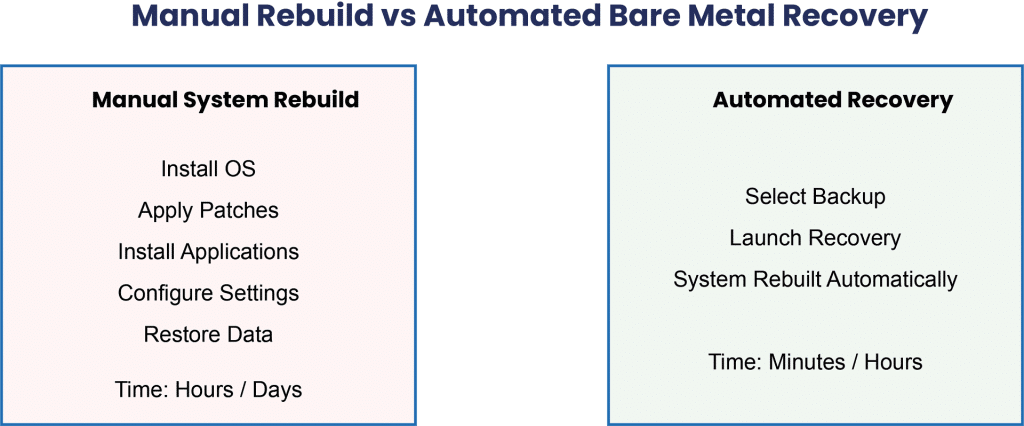
Automated recovery dramatically reduces system rebuild time.
Modern bare metal recovery solutions automate the entire system restoration process.
This allows organizations to:
Cristie Bare Machine Recovery (CBMR) enables organizations to automate the restoration of physical, virtual, and cloud systems directly from backup data.
This capability is particularly valuable during large-scale cyber incidents where multiple systems must be rebuilt quickly.
Today’s IT environments are rarely confined to a single infrastructure.
Organizations operate across:
Bare metal recovery solutions must support recovery across these environments.
Cristie solutions integrate with enterprise backup platforms such as Cohesity, Rubrik, Dell Technologies, and IBM, enabling organizations to restore systems quickly regardless of where workloads run.
During a cyber incident, rapid infrastructure recovery helps organizations:
The faster compromised systems can be rebuilt, the sooner organizations can resume normal operations.
Cyber resilience strategies increasingly rely on automated system recovery.
Bare metal recovery ensures organizations can:
Combined with backup, security monitoring, and recovery testing, BMR forms a critical layer in modern cyber resilience architectures.
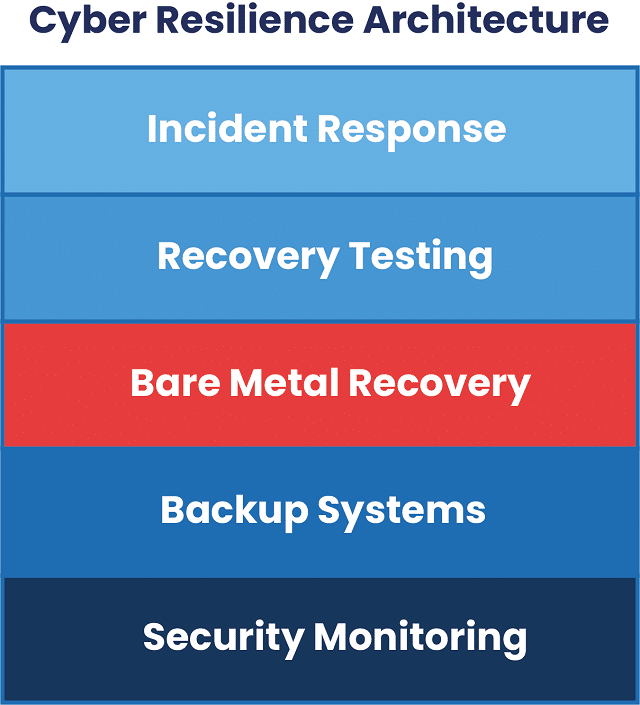
Bare metal recovery forms a foundational layer of modern cyber resilience strategies.
Cristie Software provides enterprise-grade recovery solutions that enable organizations across multiple industries to restore complete systems quickly and securely.
Cristie solutions support:
This helps organizations achieve faster recovery times and stronger cyber resilience.
Bare metal recovery restores an entire system—including operating system, applications, and data—onto new or rebuilt hardware.
Ransomware attacks can corrupt entire systems. Bare metal recovery enables organizations to rebuild compromised servers quickly from trusted backup sources.
By automating the restoration of entire systems, bare metal recovery eliminates manual rebuild processes and significantly accelerates infrastructure recovery.