




운영 복원력 간소화 EU DORA 및 영국 FCA/PRA 지침에 대한 운영 복원력 간소화

금융 기관은 2025년 1분기까지 운영 복원력을 입증해야 합니다.

지원 방법

대규모 물리적 시스템 복구 자동화

모든 시스템의 부팅 관리 간소화

검증 및 사이버 포렌식을 위해 격리된 네트워크로 복구하기

버튼 클릭 한 번으로 테스트 환경 재설정하기

Cristie 시스템 복구는 대규모 서버 자산에서 지원되는 중요하고 중요한 서비스의 복구를 용이하게 하기 위해 대량 시스템 매핑을 위한 다양한 방법을 제공합니다. 저희 소프트웨어는 일반적인 부팅 관리 솔루션과 통합되어 물리적 및 가상 시스템 모두에 대한 복구 프로세스를 간소화합니다. 운영 환경과 완전히 격리된 샌드박스 환경에서 검증 및 사이버 분석을 위해 시뮬레이션 복구를 수행할 수 있습니다.

시스템 복구

계층화된 시스템 복구를 오케스트레이션하여 애플리케이션 및 서비스 종속성을 지원하세요.

수동 개입 없이 물리적 머신의 복구를 자동화하세요.

시스템 복구 시간을 개선하여 FCA/PRA 및 DORA 내충격성 목표를 충족합니다.

물리적 시스템을 복구하려면 기존의 복구 방법으로는 수작업이 필요한 경우가 많습니다. Cristie 소프트웨어 시스템 복구 솔루션은 물리적 시스템의 복구를 자동화하여 대규모 시스템 복구에 큰 장애가 될 수 있는 수동 개입의 병목 현상을 제거할 수 있습니다.

복원력 테스트

ML 기반 결과 로그 파일 분석으로 시뮬레이션된 복구를 자동화하세요.

DORA 제12조에 규정된 대로 물리적, 논리적으로 분리된 시스템으로 복구합니다.

중요하고 중요한 기능에 대한 복구 시간과 복구 지점 목표를 쉽게 테스트하여 합의된 서비스 수준을 충족하는지 확인할 수 있습니다.

FCA 복원력 테스트: 금융감독청 정책 성명서 PS21/3의 5장에서는 보호 대상 서비스의 규모, 규모 및 복잡성에 비례하여 기관이 수행해야 하는 매핑 및 시나리오 테스트에 대한 높은 수준의 보기를 제공합니다.
DORA 복원력 테스트: DORA 최종본의 제12조(백업 정책 및 절차, 복원 및 복구 절차 및 방법)는 백업 절차 테스트와 주기적으로 수행해야 하는 중요 서비스에 대한 복원 및 복구 절차에 관한 보다 포괄적인 방향을 제시합니다.
Cristie 머신 러닝을 적용하여 시스템 복구 성능을 개선했습니다.

운영 복원력

중요하고 중요한 비즈니스 서비스를 위한 대규모 복구를 간소화하세요.

복구 프로세스에 고급 이상 징후 탐지 기능을 통합하세요.

과도기 기간 내에 복원 및 복구 절차 및 방법을 가속화하세요.

효율적인 시스템 복구를 구현하는 것은 핵심적이고 중요한 비즈니스 서비스에 운영 복원력을 구축하기 위한 기본 요소입니다. Cristie 소프트웨어 시스템 복구 솔루션은 IBM, Dell Technologies, Rubrik, Cohesity의 선도적인 백업 솔루션과 함께 대규모 시스템 복구를 용이하게 하도록 설계되었습니다.
Cristie 소프트웨어로 운영 복원력을 간소화하는 방법을 알아보세요.

CBMR 작동 방식

CBMR에 대해 자세히 알아보세요.

CBMR은 사용자가 지정한 데이터 파일과 데이터베이스는 물론 전체 시스템의 백업을 생성하는 간단하면서도 강력한 백업 소프트웨어 솔루션입니다. 백업은 네트워크 공유, 테이프 장치, 라이브러리, 독립형 NAS 또는 Spectrum Protect를 사용하여 보관할 수 있습니다.

이 소프트웨어는 시스템 장애 또는 인적 오류 발생 시 운영 체제를 신속하게 복구할 수도 있습니다. 복구된 머신은 다른 하드웨어나 가상 머신 또는 클라우드 머신에 있을 수 있습니다.

CBMR은 기존 백업에서 새 머신으로 복제하는 기능도 제공합니다. 복제 옵션을 사용하면 복구 중에 호스트 이름 및/또는 IP 주소를 변경할 수 있습니다.

CBMR을 사용하면 컴퓨터 또는 네트워크에 연결된 모든 백업 위치(FTP(Windows만 해당), 테이프, VMware, Hyper-V, Spectrum Protect, AWS 및 OCI 공용 클라우드 포함)에 시스템 내 데이터를 백업할 수 있습니다. 그런 다음 백업의 내용을 검토하고 원하는 파일이나 디렉터리를 복원할 수 있습니다.

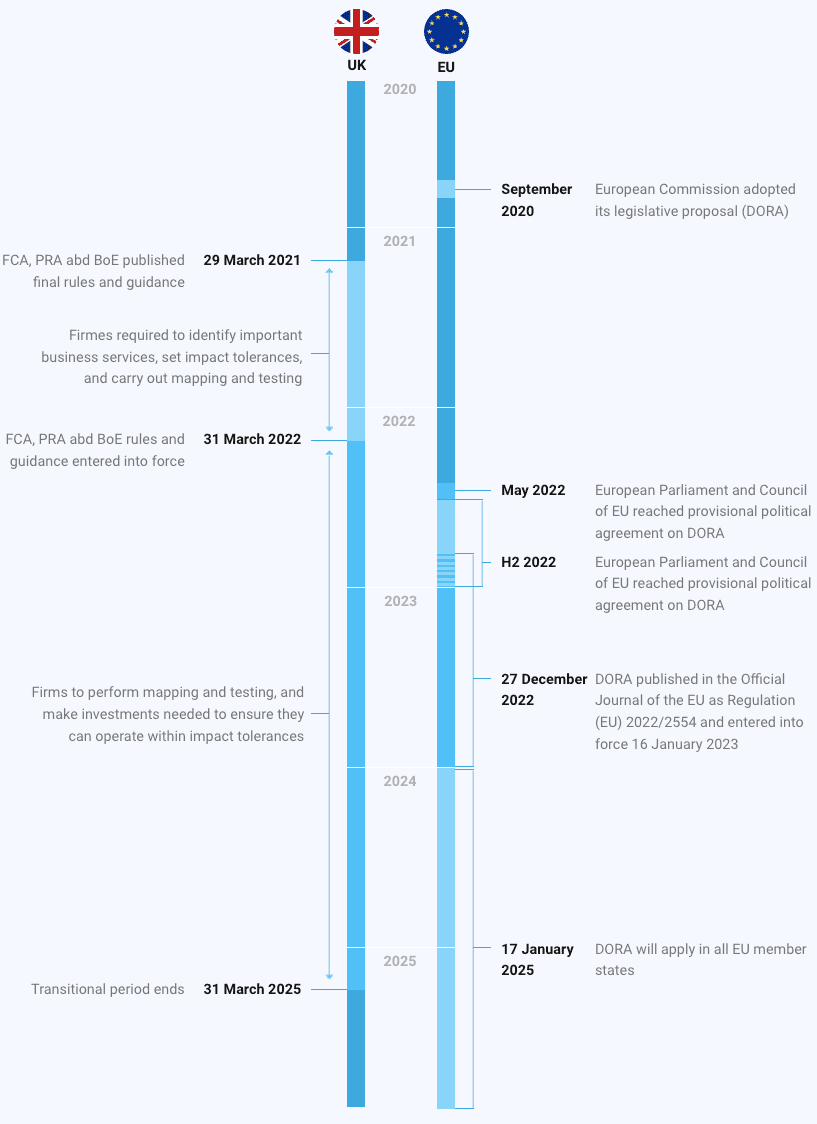
영국 FCA/PRA 및 EU DORA 타임라인

https://www.cristie.com/wp-content/uploads/2024/01/timeline1_uk_eu.png
2020
2021년 3월 29일
2020년 9월
2022년 5월
H2 2022
12월 27일
2022
2025년 1월 17일
2022년 3월 31일
2025년 3월 31일
FCA, PRA abd BoE, 최종 규칙 및 지침 발표
중요한 비즈니스 서비스를 식별하고, 영향 허용 범위를 설정하고, 매핑 및 테스트를 수행해야 하는 기업
기업은 매핑 및 테스트를 수행하고, 영향 허용 범위 내에서 운영할 수 있도록 필요한 투자를 해야 합니다.
유럽연합 집행위원회, 입법 제안서(DORA) 채택
유럽의회와 EU 이사회가 DORA에 대한 잠정적 정치적 합의에 도달했습니다.
DORA는 규정 (EU) 2022/2554로 EU 공식 저널에 게재되었으며 2023년 1월 16일 발효되었습니다.
DORA는 모든 EU 회원국에 적용됩니다.
FCA, PRA abd BoE 규정 및 지침 발효
과도기 종료
2021
2022
2023
2024
2025
UK
EU

리소스

CBMR 작동 방식

CBMR - 워크플로 시퀀스

CBMR은 보호하는 시스템당 하나의 라이선스가 필요하며 12개월 무료 지원 및 유지 관리가 포함됩니다. 여기에서 가격 책정에 대해 자세히 알아보세요.

Cristie 소프트웨어 블로그

Continuous Recovery Assurance for DRaaS providers from Cristie Software

Turn DRaaS from passive protection into a recovery certified solution with Continuous Recovery Assurance

DRaaS: Automatically prove recoverability of every backup with Continuous Recovery Assurance What is Disaster Recovery as a Service (DRaaS)? Disaster Recovery as a Service (DRaaS) is a cloud-based solution that enables organizations to back up critical systems and data and quickly restore them in the event of a disaster, whether it’s caused by cyberattacks, hardware failure, natural events, or human error. Unlike traditional backup approaches that often require manual intervention and on-premises infrastructure, DRaaS replicates entire systems—including operating systems, applications, and configurations—to a secure cloud environment. This allows businesses to recover their IT operations remotely and rapidly, minimizing downtime and maintaining business continuity. With flexible, scalable delivery models, DRaaS is particularly valuable for organizations seeking to reduce the complexity, cost, and risk of managing disaster recovery in-house. Traditionally, DRaaS does not include automated recovery verification – this is where Cristie Continuous Recovery Assurance transforms the capabilities for DRaaS providers and end users.   The DRaaS Market Surge: What’s Driving Growth According to a 2025 market‑forecast report from Knowledge Sourcing Intelligence, the global Disaster Recovery as a Service (DRaaS) Market is projected to expand from USD 13.660 billion in 2025 to USD 30.629 billion in 2030, representing a robust compound annual growth rate (CAGR) of 17.53%. This strong growth outlook reflects a broad shift in enterprise IT strategies. Rapid digital transformation, rising ransomware and cyber‑threat risk, and regulatory pressure for business continuity are fuelling demand for cloud‑based disaster recovery. Organizations increasingly prefer DRaaS over traditional on‑premises disaster recovery, drawn by scalability, cost efficiency, and operational agility. Other market studies echo this trend: for example, a report by Grand View Research estimates the DRaaS market will grow to USD 74.34 billion by 2030, driven by growing demand for business continuity and data protection. (Grand View Research) $13.66B DRaaS Market 2025 Current global market value $30.63B Projected 2030 Expected market expansion 17.53% CAGR Growth Compound annual growth rate   What this means for IT Decision Makers and MSPs? For IT leaders, C‑level executives, and MSPs (Managed Service Providers), the projected DRaaS growth signals three important shifts:   DRaaS is becoming mainstream From a niche to a core component of IT resilience strategy. In fact, some organizations are deploying DRaaS within their own private cloud networks. ✅   Higher expectations around recovery reliability With more organizations depending on DRaaS, “simply having backups” is no longer enough — customers now expect recovery guarantees. ✅   Opportunities for MSPs to differentiate Providers that offer not only replication, but automated and validated recovery workflows will gain an edge in service quality and trust. ✅ This is where advanced capabilities like Continuous Recovery Assurance become a differentiator.   Continuous Recovery Assurance: From Backup to Verified DRaaS Recovery Traditional DRaaS focuses on backing up data or replicating systems; it rarely ensures that those backups can be reliably restored when disaster strikes. That “hope‑and‑pray” model leaves organizations vulnerable; especially in ransomware or major outage scenarios when time is critical. Cristie Software addresses this gap through its Continuous Recovery Assurance capability, an approach that automates system recovery validation within a Clean Room environment after the completion of each successful backup job, giving confidence that: Backups are intact Backups have integrity and have not been corrupted or encrypted. System restores will succeed Entire system restores will succeed, including OS boot & application health. System restores will succeed Entire system restores will succeed, including OS boot & application health. Full stack recovery Recovery works across the full stack: OS, applications, data — not just files. In effect, Continuous Recovery Assurance turns DRaaS from passive protection into an actively verified, resilience‑certified service.   Why Continuous Recovery Assurance Matters for MSPs and End Users For Managed Service Providers Service differentiation. MSPs can offer “recovery‑proven DRaaS,” a premium service level that companies increasingly demand. Reduced liability and risk. By proving recovery workflows periodically, MSPs minimize the risk of failed restores, a key concern in SLAs and compliance audits. Scalability and automation. Cristie’s system supports scheduled, repeatable tests, enabling MSPs to validate hundreds of customer systems without manual overhead. For End Users (Enterprise IT Teams) Confidence in business continuity. Continuous Recovery Assurance reduces uncertainty, especially in cyber‑resilience planning and disaster‑recovery testing. Faster, predictable recovery. In an outage, organizations can restore with minimal downtime, knowing that backups are verified and recoverable; not just “there somewhere.” Regulatory and compliance support. Many regulations require not just backups, but proven recoverability; an area where verified recovery helps meet audit and compliance standards.   The table below highlights the differences between Traditional Backup, Disaster Recovery as a Service (DRaaS), and DRaaS with Cristie Continuous Recovery Assurance: Feature / Capability Traditional Backup DRaaS DRaaS with Continuous Recovery Assurance Automatic Testing / Validation of Backups Manual (if done at all) Some periodic testing ✅ Fully automated, ongoing recovery testing Cyber Resilience Limited recovery might fail after an attack Improved, but still risk of untested backups ✅ High: Automated verification ensures backups are reliable Complexity of Setup & Maintenance Requires in-house effort and hardware Managed by service provider ✅ Fully automated with added validation layer Cloud Integration / Flexibility Minimal Cloud-native or hybrid capabilities ✅ Cloud-ready with support for physical, hybrid and multi-cloud Cost Efficiency Lower upfront, but high TCO over time Subscription-based; better scalability ✅ Efficient cost-to-value ratio with reduced failure risk Usability for MSPs Limited Offers services, but with manual verification ✅ Ideal for MSPs: Adds service value with automated testing Regulatory Compliance Support Depends on in-house expertise Better, but needs manual audit support ✅ Enhanced audit-ready with validated recovery records User Confidence in Recovery Often uncertain Moderate ✅ High: Backed by ongoing successful recovery tests Key: ✅ = Feature is robust and built-in Positioning Cristie Software in Today’s DRaaS Surge By offering Continuous Recovery Assurance, Cristie Software sets a higher bar: not just replication or bare metal recovery (BMR), but recovery‑verified resilience. That makes Cristie a valuable partner for both MSPs seeking to offer top‑tier DRaaS, and enterprises needing guaranteed data integrity and rapid recovery. Continuous Recovery Assurance can automatically validate

자세히보기"
Cristie 소프트웨어, Dell Technologies PowerProtect Data Manager용 시스템 복구 PBMR 출시

Cristie 소프트웨어, Dell Technologies PowerProtect Data Manager용 시스템 복구 PBMR 출시

Cristie 소프트웨어, 델 테크놀로지스 파워프로텍트 데이터 매니저용 시스템 복구 PBMR 출시 Cristie 소프트웨어는 델 테크놀로지스 파워프로텍트 데이터 매니저를 위한 자동화된 시스템 복구 및 검증을 제공하는 시스템 복구 PBMR의 일반 공급을 발표했습니다. 영국 런던, 2025년 9월 15일 - 시스템 복구, 복제 및 마이그레이션 기술 분야의 선도업체인 Cristie Software는 오늘 Dell Technologies PowerProtect Data Manager용 Cristie System Recovery PBMR의 일반 공급을 발표했습니다. 이 새로운 통합 기능은 전체 시스템 복구 기능으로 PowerProtect Data Manager 환경을 확장하여 물리적, 가상 또는 클라우드 기반 타겟에 대한 베어 머신 복구(BMR)를 가능하게 합니다. 또한 PBMR은 보호된 시스템에서 새 백업이 감지될 때마다 클린룸 환경에서 전체 시스템 복구를 자동으로 수행하는 연속 복구 보증을 비롯한 강력한 자동 복구 도구를 제공합니다. Cristie시스템 복구 포트폴리오를 강화하는 PBMR은 기존 Dell Technologies Avamar 및 Networker 플랫폼용 솔루션에 추가되었습니다. "지난 10여 년 동안 우리는 강력한 시스템 복구 기능으로 Dell Technologies 백업 소프트웨어 사용자의 역량을 강화해 왔습니다. Dell 고객이 최신 백업 기술과 완벽하게 호환되는 원활하고 현대적인 복구 툴의 이점을 누릴 수 있도록 솔루션을 지속적으로 발전시키게 되어 자랑스럽습니다."라고 Cristie Software의 비즈니스 개발 부사장 Scott Sterry는 말합니다. "오늘날의 진화하는 사이버 보안 환경에서 기업은 사이버 회복탄력성을 위해 특별히 구축된 강력한 시스템 복구 인프라스트럭처를 구현하는 것이 중요합니다. 지속적인 복구 보증은 특히 의심스러운 파일 암호화 및 잠재적 맬웨어 활동에 대한 조기 경고를 제공하는 고급 이상 징후 탐지 같은 기능을 통해 지속적인 혁신을 통해 복원력을 강화하려는 Cristie 소프트웨어의 노력을 반영합니다." Cristie 소프트웨어 PBMR은 별도의 백업 작업 관리 없이도 Dell Technologies PowerProtect Data Manager 내에서 전체 시스템 복구 기능을 추가합니다. Dell Technologies 고객은 Cristie 소프트웨어 또는 글로벌 Dell Technologies 파트너 네트워크를 통해 PBMR 라이선스를 구매할 수 있습니다. Cristie Software 소개 2008년에 설립된 Cristie Software는 고급 시스템 복구 및 복제 솔루션을 통해 70여 개국에서 3,000명 이상의 사용자를 지원하고 있습니다. 의료, 소매, 제조, 공공 부문 및 금융 서비스 분야의 세계 유수 조직에 서비스를 제공하고 있으며, 글로벌 포춘 500대 기업 중 1/3이 신뢰하고 있습니다. 파트너 및 리셀러로 구성된 글로벌 네트워크를 통해 운영 연속성과 복원력을 보장하는 효과적이고 동급 최강의 솔루션을 제공합니다. 크리스티의 기술은 Cohesity, Rubrik, Dell, IBM을 비롯한 전략적 파트너들이 전 세계적으로 추천하고 있으며, 고객들에게 안전하고 자동화된 시스템 복구 및 복구 오케스트레이션을 제공하고 있습니다. Cristie 소프트웨어는 복구 및 복제 프로세스를 위한 자동화 및 머신 러닝에 중점을 둔 특허 기술을 보유하고 있으며, 현재 특허 심사 중인 몇 가지 혁신 기술을 추가로 보유하고 있습니다. Cristie 독점 소프트웨어를 개발하는 것 외에도 IBM으로부터 SysBack 라이선스 및 개발 권한을 획득하고 Storix를 인수하는 등 전략적 인수를 통해 포트폴리오를 확장하고 있습니다. 자세히 알아보기 www.cristie.com

자세히보기"
코헤시티 베리타스 합병: Cristie 소프트웨어 BMR이 자동화된 대규모 복구를 실현하는 이유

코헤시티 베리타스 합병: Cristie 소프트웨어 BMR이 자동화된 대규모 복구를 실현하는 이유

Cohesity Veritas Merger: Why Cristie Software BMR Unlocks Automated, Large-Scale Recovery Introduction: A New Era for Enterprise Backup and Recovery The merger of Cohesity and Veritas marks a defining moment in the enterprise backup and recovery market. By combining Cohesity’s modern, cloud-native innovation with Veritas’ decades of market presence, Cohesity Veritas now represents one of the largest data protection companies in the world. While both platforms offer powerful backup and recovery features, many enterprises face a common challenge: how to recover entire server estates quickly and at scale after a disaster. This is where Cristie Software’s Bare Machine Recovery (BMR) solutions—CoBMR for Cohesity and CBMR for Veritas—play a transformative role. The Cohesity–Veritas Merger at a Glance The merger brings together: Cohesity DataProtect: a cloud-ready, scalable backup and recovery platform. Veritas NetBackup: a trusted enterprise backup system with global adoption. Together, they offer customers a unified choice of solutions for hybrid and multi-cloud environments. Backup Strengths of Cohesity and Veritas Cohesity DataProtect: Modern, Scalable Data Protection Cohesity is known for: Unified data management. Cloud-native integration. Rapid backup and restore of VMs, databases, and applications.   Veritas Backup: Traditional Strengths and BMR Capabilities Veritas NetBackup has a BMR feature, but its automation capabilities are limited. Enterprises often find it difficult to scale BMR across large, diverse server estates without manual intervention. The Bare Machine Recovery Challenge Why BMR Is Essential for Enterprise IT Bare Machine Recovery (BMR) restores entire systems from scratch—including the operating system, applications, and configurations. It’s crucial for: Disaster recovery after ransomware or hardware failure. Cloud migrations. Hardware refresh projects. Limitations of Veritas Native BMR While Veritas includes BMR, it lacks the automation depth needed to handle large-scale recovery across hundreds or thousands of physical servers. This gap creates risks in disaster recovery planning. Cristie Software’s Advanced BMR Solutions Cristie CoBMR for Cohesity DataProtect CoBMR integrates directly with Cohesity backups, adding full-system recovery and hardware-independent restores to physical, virtual, or cloud platforms. Cristie CBMR for Veritas NetBackup CBMR extends Veritas NetBackup by providing advanced automation and orchestration for bare machine recovery, scaling to enterprise server estates. The Key Advantage: Automation at Scale Automating Full Server Estate Recoveries Cristie BMR solutions allow IT teams to automate the recovery of entire physical server estates—saving countless hours during large-scale incidents. Consistency, Speed, and Reduced Human Error Automated workflows ensure: Faster recovery times. Reduced manual effort. Consistent and repeatable outcomes.    Benefits of Adding Cristie BMR to Cohesity Veritas Environments Faster RTOs and Greater Flexibility – Get critical systems online within hours, not days. Large-Scale Disaster Recovery for Physical Servers – Recover entire estates in parallel with minimal manual steps. Seamless Multi-Platform Recovery – Restore workloads across physical, virtual, and cloud platforms.   Real-World Use Cases Enterprise Data Center Recovery After Ransomware – Rapid restoration of hundreds of servers simultaneously. Large-Scale Hardware Refresh or Cloud Migration – Move workloads seamlessly between platforms. Automated Compliance Testing of DR Plans – Prove recovery capabilities for audits with scheduled, automated testing.   Why Cristie BMR Complements the Cohesity Veritas Merger Closing the Automation Gap in Veritas BMR While Veritas offers BMR, Cristie’s CBMR adds automation that scales for modern enterprise needs. Strengthening Cohesity Veritas for Hybrid and Multi-Cloud IT By combining Cohesity’s cloud innovation, Veritas’ market presence, and Cristie’s BMR automation, enterprises achieve a future-proof recovery strategy. FAQs on Cristie BMR with Cohesity and Veritas Q1: Does Veritas already include BMR?A1: Yes, Veritas NetBackup includes basic BMR, but it lacks automation for large-scale recovery. Cristie CBMR fills this gap. Q2: How does CoBMR enhance Cohesity DataProtect?A2: CoBMR enables bare metal recovery from Cohesity backups, with full automation and hardware independence. Q3: Can Cristie BMR solutions recover to cloud platforms?A3: Yes, both CoBMR and CBMR support recovery to cloud, physical, and virtual environments. Q4: Is Cristie BMR suitable for large enterprises?A4: Absolutely—Cristie solutions are designed to automate recovery of large physical server estates at scale. Q5: Does Cristie BMR support automated recovery testing?A5: Yes, automated recovery testing ensures compliance and verifies that DR plans will work when needed.   Conclusion: Future-Proofing Recovery with Cristie Software The Cohesity–Veritas merger creates a new force in data protection. Yet, for enterprises with complex infrastructures, automation and scalability in bare machine recovery remain critical. By integrating Cristie CoBMR for Cohesity and Cristie CBMR for Veritas, organizations gain the ability to automate large-scale recovery, reduce downtime, and ensure business continuity in even the most demanding disaster scenarios. Learn more about Cristie Software Bare Machine Recovery.

자세히보기"

자세한 내용은 Cristie 소프트웨어 팀에 문의하세요.

복제 및 데이터 복구에 필요한 것이 무엇이든 저희가 도와드리겠습니다.

https://www.cristie.com/wp-content/uploads/2022/09/thub-logo1.png

문의하기

https://www.cristie.com/wp-content/uploads/2022/09/thub-logo1.png

문의해 주셔서 감사합니다. 요청을 받았습니다.

https://www.cristie.com/wp-content/uploads/2019/06/gdpr_130px.png
개인정보 개요

본 웹사이트는 사용자에게 최상의 사용자 경험을 제공하기 위해 쿠키를 사용합니다. 쿠키 정보는 사용자의 브라우저에 저장되며, 사용자가 웹사이트에 다시 방문할 때 사용자를 인식하고 사용자가 가장 흥미롭고 유용한 웹사이트 섹션을 이해하는 데 도움을 주는 등의 기능을 수행합니다.